 Zühlke× DBTZühlke× DBT
A bid for the Department for Business & Trade AI Capability Programme
A 24-month programme to help DBT's 3,200 staff use AI safely in real work: skills, governance, culture and measurable adoption.
Two phases · 24 months · £7.5M · Proof before scale
What DBT asked suppliers to solve

The lesson from Meridian, DBT's previous programme
Why Meridian matters: DBT has already bought activity that did not change behaviour.
Activity is not
capability.
Capability means people repeatedly doing real work better and safer. Meridian did not fail through effort. It failed because training, governance and ownership were not built into the work.

Why the last programme did not change behaviour
Our answer

We redesign real workflows from the inside — capability built into how the task is done, never standalone training.

Governance grows from the live use cases teams actually run — so it's usable, and used. We adopt and tailor the AI Playbook, not a shelf document.

Named DBT owners, a funded community of practice, a month-18 sustainability gate. What we build survives us.
The commercial difference
Meridian was paid for a catalogue. We're asking to be paid for behaviour that's still there after we leave. We set a baseline in the first weeks — then a slice of our Phase 2 fee, and the decision to continue, ride on adoption that persists.
If the change isn't real, you shouldn't pay us as though it were.
Phase 1 · Prove the approach · months 1–6 · ~£1.5M
Mobilise. Lock in Director-level sponsors. Set the baseline — you can't prove value without it.
Refresh your 2022 segmentation. Discovery across directorates. A shadow-AI audit — surfacing real risk and real value.
A governance framework people actually follow, and live lighthouse pilots in the directorates that want it.
Deliverables expressed as outcomes, not documents. A clear go / no-go at month 6 — you are not locked in.

Phase 2 · Scale what works · months 7–24 · ~£6.0M
Adoption sequence
Investment and your data analysts go first — that's where proof comes fastest. We approach Trade Policy and Legal last, on their terms: accuracy-first, the human expert always in the loop.
We treat the 2024 Legal incident as the reason to be careful everywhere — not a footnote.
Why this fits the current government context
You're facing a national challenge — with a method to answer it.
Proof you can see — not discovered at the end
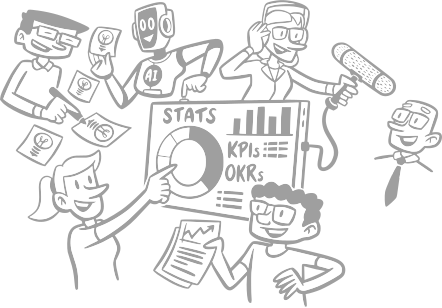
Sustained active use in named teams, against a baseline, on a live dashboard. Dashed line = where you started.
Built into delivery, not bolted on
The social value commitments are delivered through the programme itself.


The delivery team
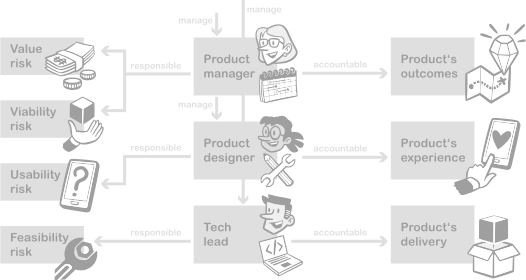
Not AI experts seeing a department for the first time — people who understand how a large, policy-heavy organisation actually changes.
Programme & Delivery · Engagement · Technical & Data · Discovery & Measurement · Capability & Engineering · Enablement & Tooling
The team shrinks as your capability grows. We get cheaper as you get better.
Programme risks we will manage openly
They're written down, with mitigations — because the risks that sink programmes are the ones nobody said out loud.
The test we're happy to be judged on
In twelve months: named teams doing real work measurably better, safely, and still doing it after we've stepped back. Less dependency over time is the point.
Zühlke. DBT AI Capability Programme